How to Determine Prices for Business Services

Coming up with a business idea is only half the battle. Determining a price for your services is another huge part. As a business owner, you need to specify a price for your benefits before you can start offering them to potential customers, and if you can’t provide your services, you can’t make any money. So setting the right price is one of the crucial first steps in setting up your business.

If you were giving away your services for less than cost or just breaking even, you’d be operating a non-profit venture – or a business that’s likely to fail. There are various components that factor into whether or not a business is profitable, including location, leadership, market demand, competition, and so on.

Many service-based businesses struggle to come up with a fair and profitable pricing strategy. Unlike product pricing, you can’t precisely quantify all the costs that go into providing a service. 

The expenses that go into providing a service are more subjective than those that go into making a product. How much you charge customers doesn’t always directly correlate with the amount you pay to perform services. If you own a retail store, you buy goods at a specific price. 

To earn a profit, you need to sell the goods for more than what you paid. You determine how to price a product according to its cost. In service industries, finding a target profit margin is not as simple. You don’t have an original price to reference. Instead, your pricing formula for services should account for the intangible aspects of running your business, such as time and value.

Factors to Consider For Pricing

In short, pricing services is a tricky business. Because there is no set-in-stone method for pricing services, you have some flexibility in setting your price, but there isn’t a guaranteed formula that will enable you to set your price.

Here are the factors that experts say you should consider when trying to determine what price to charge for a service:

1.       Cost-plus pricing

This standard method of pricing in business seeks to determine the cost of making a product or, in this case, providing a service, and then add an amount to represent the desired profit. 

To determine the cost, you need to figure out direct costs, indirect costs, and fixed costs. Those costs include a portion of your rent, utilities, administrative fees, and other general overhead costs. When you make a deal to sell a service, you have to cover all your expenses.

2.       Competitors’ pricing

You need to be aware of what competitors are charging for similar services in the marketplace, Osteryoung says. This information could come from competitor websites, phone calls, talking to friends, and associates who have used a competitor’s services, published data, etc. 

If you have to compete on price to win a customer, you may ask yourself whether they will be loyal to you if they find someone offering a service at a lower price. 

To be relevant in the market, you need to convince potential customers that you are giving them tremendous value in terms of use and quality. To do that, you must be aware of what the competition is charging.

3.       Perceived value to the customer

This is where a lot of the subjectivity comes in when setting a service price. The critical factor in determining how much they are willing to pay for a service may not be how much time you spent providing the service to your customer. Still, ultimately what the perceived value of that service and your expertise is to them, Osteryoung says. That is where pricing becomes more of an art form.

How to Price Business Services

Guidelines For Setting Pricing For Your Services

Calculate your costs

Before you set a price for the services your company will provide, you need to understand your costs of providing these services to customers. The U.S. Small Business Administration advises that the cost of producing any use consists of the following three parts:

1.       Materials cost: These are the costs of goods you use in providing the service.

2.       Labor cost: This is the cost of direct labor you hire to provide a service.

3.       Overhead costs: These are the indirect costs to your business in providing services to customers. Examples include labor for other people who run the firm, whether administrative assistants or human resources personnel. 

Other overhead costs include your monthly rent, taxes, insurance, depreciation, advertising, office supplies, utilities, mileage, etc. The SBA suggests that a reasonable amount of these overhead costs should be billed to each service performed, whether at an hourly rate or a percentage.

Determine a fair profit margin.

Once you determine your costs, you need to mark up your services to ensure that you achieve your business profit; This is a delicate balance. You want to ensure that you complete a desirable profit margin. Still, at the same time, particularly in a down economy, you want to make sure that your business doesn’t get a reputation for overcharging for services.

Pricing Models.

Now that you understand what it costs you to provide a service, what your competitors are charging, and how customers perceive your services’ value, it’s time to figure out whether to charge an hourly rate; a per-project rate, try to negotiate a retainer for your assistance. This may be predetermined by your industry and the type of service pricing that predominates in your sector. 

For example, lawyers tend to charge hourly rates for their services, although those rates can vary. Many construction firms charge a project fee and require that one third be paid upfront, another third be paid at the half-way point, and the remaining third be paid upon completion.

1.       Charging at an hourly rate.

2.       Charging a flat fee.

3.       Variable pricing: Involves taking advantage of the flexibility afforded by service pricing to negotiate different prices to varying customers.

Conclusion

In a service business, your highest costs are usually your people’s costs — salaries, benefits, etc. If you are having a hard time selling services at an acceptable profit, the problem may be that your employee costs are too high rather than the price is too low. 

You may also want to re-evaluate your overhead costs to determine whether there are other cuts you can make to bring your price down and your profit margin up. Keep track of the profitability of your company every month. Always be testing new prices, new offers, and new combinations of benefits and premiums to help you sell more of your services at a better and better price. If you never raise your expenses, you won’t be in business for long. 

You have to continually monitor your worth and your costs to be competitive in the market and make the kind of money you deserve to complete in your business.

Position to Profit Membership

The Good, The Bad, and The Profit of Being Your Own Boss

Being an entrepreneur has its pros and cons. Running a business and being your boss sure has its benefits. However, roses have thorns. A proper understanding of an entrepreneur’s life would help you prepare for the positive and negative aspects of running a business.

While running a business affords you a sense of happiness and fulfillment, stress and pressure are also significant parts of the package. It’s a packaged deal of freedom and control, mixed with long hours and compulsory dedication.

Benefits of being an Entrepreneur

You are the boss

Being the boss is a rather obvious benefit of being an entrepreneur. It is one of the primary reasons why being an entrepreneur is so fulfilling and attractive. You are in control, the captain of the ship calling the shots and making things happen. 

Your thoughts and decisions make real impacts. It is way better than submitting suggestions to a middle manager who ignores them or takes credit for them. Every move you make affects real impact and change. 

You are in charge of your earning and finances

Another significant advantage of being an entrepreneur is that you determine how much you earn. You have the power to improve your earnings. How much you make isn’t left to the mercy of your boss or some obscure company policy. 

How much you make is based on the effort you put into your business and how much you decide to pay yourself. Of course, you must be careful not to suck your business dry. Nevertheless, financial independence is a major source of joy for all entrepreneurs.

Flexible working hours

Another major advantage of being your boss is flexible working hours. You get to decide when and how long you work. You can organize your schedule so you work at the time you are most effective. For instance, if you are a night owl, you can manage your schedule to sleep during the day and work through the night; This is impossible in a corporate 9-5 job.

Flexible working condition

As an entrepreneur, you get to determine and influence the environment in which you work; This ranges from equipment, co-workers, furniture, office location, etc. You get to create the perfect conditions for you and your business to grow by surrounding yourself with the right people and the right ambiance.

Job security

Being an entrepreneur means you can’t get fired. The fear and pressure of getting that threatening letter from your boss don’t exist. Your drive to work hard is based purely on achieving your goal and taking your business to the highest peak possible. Your motivation is positive enthusiasm to meet your full potential.

The joy of building something real

The joy of creating and nurturing a business is so overwhelming and fulfilling. Building your business from the ground up brick by brick, client by client, project by project, and sale by sale is bound to fill you with a sense of achievement. There is a special and joyous pride that comes with being the owner and builder of a successful business. That feeling is worth more than silver or gold.

The good, the bad and the profit of being your own boss.

Cons of Being an Entrepreneur

Your clients and team are your employers

As an entrepreneur, you are your boss. However, you are still accountable for a lot of people. You are responsible for your clients and customers. In many ways, you are responsible for your teammates whose careers are in your hands. If you want to run a successful business and lead an efficient team, you have to relate with everyone with guided respect and care. To be a good entrepreneur, you have to be answerable to your clients, customers, and employees. Treating them with respect and thriving for their joy and satisfaction is a necessary ingredient for success.

Long hours, pressure, and stress

Being an entrepreneur requires impossible hours. Sometimes you had wished there were more than twenty-four hours in a day. Success in entrepreneurship usually requires dedication, consistency, and determination. Everything hangs on your shoulders. There is no pressure or fear of getting fired. However, the task of keeping your business running and growing is enough to keep you busy and under intense pressure.

Financial insecurity

One secret that most people tend to miss is that with financial independence comes financial insecurity. Earning a salary gives you a steady stream of income, making it easy for you to plan for the future. However, as an entrepreneur, your rating is reliant on the success of your business and the market and economic cycles.

In essence, you don’t know for a fact how much you or your company would earn. Plans and projections are essential; however, they are not guaranteed. The business world is very fluid, and so is the financial state of an entrepreneur. To stay in business and avoid brokenness, you would need to have good financial discipline and money management skills.

Conclusion

Most times, entrepreneurship is presented in a single light. Super dark or super bright. However, entrepreneurship is a spectrum, and getting a clear picture would require careful consideration of all pros and cons.

In truth, some features of entrepreneurship double as pros and cons. It all comes down to how well you manage your business.  The good news is the pros outweigh the cons by an extensive margin.

Position 2 Profit Membership

Position 2 Profit Membership is for an online business community of leaders who want to position their business for profit. Business evolves at a different level when profit begins and how does your business grow from there? The group is led by Allison Todd, Operations & Digital Growth Strategist. Our members are committed to building a network of referrals, resources and accountability.  Entrepreneurship is hard but you don’t have to do it alone.

How to Stay Tuned In to Your Entrepreneurial Spirit During the Pandemic

With the coronavirus on the loose and wreaking havoc on every industry globally, the life if an entrepreneur just got harder. Entrepreneurship is riddled with a lot of challenges and uncertainties.

However, this pandemic has heightened these challenges and uncertainties, making it even more difficult to run a business. In some parts of the world, running a business is downright impossible.

With many opinions and views out there on the best course for businesses and entrepreneurs to take, deciding the next step is even harder.

There is so much information and recommendations available, increasing the level of panic and uncertainties in the hearts of entrepreneurs.

What to do?

Rather than add to the growing noise and bombardment of information, we had rather keep things simple. The spirit of entrepreneurship is at its core problem solving and thinking outside the box. It’s the art of managing situations and adjusting to changes.

The virus has been affecting different sectors. While some businesses are facing booms and finding it hard to keep up with demand g. deliveries and logistics. Other companies are facing decline and finding it hard to keep the lights on e.g., restaurants and cab owners.

As an entrepreneur, now is the best time to take a step back and get in-tune with your entrepreneurial spirit. Don’t get carried away by the ocean of information and find yourself in an uncontrollable situation.

Access the situation calmly and choose a specific course of action after weighing the pros and cons, with your business and industry’s factors in mind.

Conclusion

In conclusion, the world is changing. And as life returns to a semblance of normalcy, new opportunities would come up, and some old business models would solidify. Ensure that you are in the right mindset to make the best out of the changes.

This is not the time to go with trends or make rash decisions. The key is to find the right balance between flexibility and rashness. Make quick but profoundly informed decisions, not hasty and ill-informed ones.

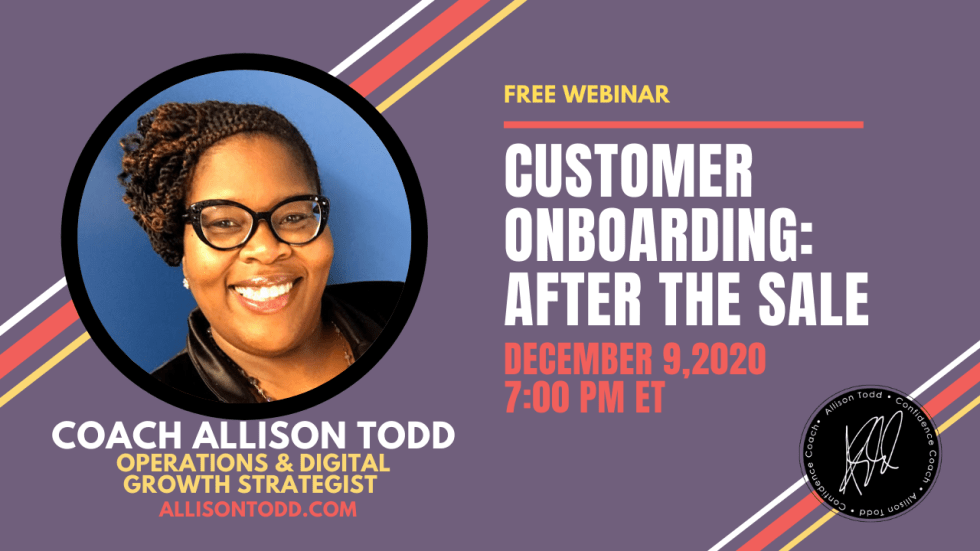
Webinar: Customer Onboarding After the Sale

This webinar Customer Onboarding After the Sale will maximize your customers’ success, satisfaction, and retention with an exceptional post-purchase plan. The strategy taught in this webinar will give you the tools to welcome your new customer.

There are two reasons your clients decide not to stay after purchase. And you want to be prepared for both. Firstly, the customer doesn’t see the value in what they purchased. Secondly, the customer doesn’t understand your product or service. As such, you will create a post-purchase system to ensure customer satisfaction and successful product use.


AFTER THE SALE

Your customer wants to hear what you have to say. After all, they made the purchase. During the event, you will create content to ensure your customers achieve their desired results with your products and services. You will also outline the automated components of your post-purchase system. Your host, Coach Allison Todd, will guide you through each module.

  • Plan the Post-Purchase Experience
  • Set Up the First 30 Days
  • Create the Process for the Next Month & Beyond

WEBINAR TAKEAWAYS

During this webinar, you will get the tools and content needed to create your post-purchase process. From start to finish, this framework guides you through the planning and implementation of your customer onboarding process. Plus, all registrants receive a free download of the 3-Step Customer Onboarding Checklist. Tell your customers what to expect up front.

  • Understand the value and necessity of having a structured customer onboarding process to aid in customer retention and future sales
  • A step-by-step process for developing a customer onboarding program
  • Identify the key customer components that motivate future sales

ABOUT COACH

Allison Todd helps micropreneurs scale their teams and their profits through operations and digital marketing strategies. She is an accomplished executive with more than 20 years invested in managing businesses, building brands, and coaching executives. As a result, her work includes a variety of consulting services such as sales, team development, digital marketing, and executive coaching.

CUSTOMER ONBOARDING AFTER THE SALE CHEATSHEET 
Customer-Onboarding-After-the-Sale-Cheat-Sheet

Scale and Grow Your Business with Allison Todd

Scale and grow your business with Allison Todd because building business is not easy. So, don’t do it all by yourself. To make the most of your business, you must consider every detail. Every stage of business has its own set of challenges. And the art of balancing the time and money investment to ensure a profitable outcome isn’t easy. Thus it requires commitment and consistency to see your plan to goal.

The difficulty of starting a business is nothing compared to the tasks of scaling a business. One of the many wows of business includes that first time you make a profit. It is the subtle reassurance that you are on the right path. But, the real hurdle is doing that over and over again. Adding resources to business, consistently while adding revenue. This is what it is to scale your business.

Ideas are the foundation of business. And business are built on plans, reliant on execution. Plan BIG. Those plans include streamlining systems and automating processes, selecting the right team, understanding data and measurements of success and more. How you plan your profitability is just the beginning.

Irrespective of your market, from small to big business, a significant determinant of your business success is the scalability. It means you are managing all aspects of your business and making a profit, as you grow. It’s a fine balancing act of every piece of your business.

Conclusion

In conclusion, it’s the planning, productivity, position, people and profits. This is what the scale to profit package offers. It is more than just a successful marketing plan, it’s your whole business.

Coach Allison Todd and her team will help position your business for profit. They provide an actionable plan for business growth. The scale-to-profit package helps to turn your small idea into a profit-generating business.

Improve Business Sales with Better Relationships

Advanced Sales and Marketing Services

Improve your business sales by attracting and developing better relationships. For instance, you must have a plan that cultivates your business value. Our sales and marketing model positions your business for profit. In other words, it helps you be less transactional and more relational. With the right customer service approach, you make a direct impact on your bottom line. Is your business ready to grow?

A well designed plan leads your customer to you, over and over again. Therefore, the goal is to focus on your current clients while attracting new ones to improve business sales. The strategy guides your customer acquisition process. Your unique selling proposition to demonstrate your business model and cultivate value.

Sales Consulting, Design and Planning

The key to customer acquisition goes beyond reduced costs. Take our sales journey and develop the road map to better business. The right model improves visibility, increases awareness, and reveals why your business stands out among your competitors. But don’t leave your competitors out of the process. It’s important to keep an eye on your industry and learn as you grow.

Above all, the best marketing plan includes word of mouth advertising to improve business sales. As a result, boost your sales by attracting your prospect. It’s important to gain an understanding of your market analysis, target audience, purchase path and buyer’s map. We are dedicated to working with business leaders who develop a brand story they are eager to share.

Our sales strategies include tactics and methods to acquire new customers and build a strong relationship. Allison Todd and team SiMar help you build the perfect sales and marketing model. For more information about our sales business expertise. Improve your business demand, contact us today!


How to Use Social Media for Small Business

Currently, there are over 3.72 billion active social media users across the world. Given its grand scale, it is high time that business organizations should consider making use of the lucrative social media platforms to improve the overall ROI.

Allison Todd –the Chief Strategist & Founder at SiMar –a leading social media marketing agency, explain social media’s importance for small businesses in the given post.

Social media is indeed a great way to connect with people who are already aware of your brand. At the same time, it also provides an excellent opportunity to reach out to new potential customers and make them aware of the products & services that your brand has to offer. Unlike the common belief, nothing is overwhelming about social media for you to worry about.

Tips for Small Business

Even when you are starting, some simple social media tricks could help you out. The leading digital marketing experts at SiMar –a reputed digital marketing agency, lay out some of the essential social media tips for your small business. Here are some:

Start with a Proper Plan

Social media tools are immensely simpler to use. You can start over by using organic posts for free to kickstart your social media marketing campaign for beginners.

Like every other reliable business marketing strategy, your social media marketing campaign should also start with a proper plan.

When you are preparing the right social media plan, here are some additional tips:

  • Set specific social media objectives. For instance, you can consider acquiring customers or raising conversion rates instead of just looking for more likes.
  • Research the competitors. Relevant competitive analysis can help you to know about working for other businesses in the given niche.
  • Conduct a proper Social Media audit. As a part of the audit process, we recommend this to look out for impostors that might be stealing your social media reputation.

Decide the Right Platforms for You

There are several social media platforms out there. Some of the famous ones are Facebook, Twitter, Instagram, LinkedIn, and others.

Depending on your social media marketing goals, you should select the right social media platform to execute the same. 

Know Your Audience Well

As you wish to target the respective audience through your social media marketing campaign, we  recommend identifying your target audience first.

With the help of relevant social media analytics, you can look forward to analyzing the end consumers’ behaviors and preferences.

Upon customizing your social media marketing strategies based on the users’ interests, you can look forward to gaining optimum success.

Expand the Audience

Once you are aware of the target audience, you can rethink the social media plan. It is time to look out for innovative ways to reach out to more target audiences in the given market. 

Conclusion

As a small business, you must pay attention to the right social media marketing strategies for optimum results.

Managing your social media can be a daunting task, and it’s good to know that there are helpful materials to guide you in using social media for your business. Here are some helpful materials to help you in incorporating social media to your business.

[maxbutton name=”Schedule” Text = “Visit Shop” URL = “https://allisontodd.com/confidence-shop/”]

The Good, the Bad and the Profit of Being Your Own Boss

Being an entrepreneur has its pros and cons. Running a business and being your own boss sure has its benefits. However, roses have thorns. A proper understanding of an entrepreneur’s life would help you prepare for the positive and negative aspects of running a business. While running a business affords you a sense of happiness and fulfillment, stress and pressure are also significant parts of the package. Its a packaged deal of freedom and control, mixed with long hours and compulsory dedication.

Benefits of being an Entrepreneur

You are the boss.

This is a rather obvious benefit of being an entrepreneur. In fact, it is one of the major reasons why being an entrepreneur is so fulfilling and attractive. You are in control, the captain of the ship calling the shots and making things happen. Your thoughts and decisions make real impacts. It is way better than submitting suggestions to a middle manager who ignores them or takes credit for them. Every move you make effects real impact and change.

You Are in Charge of  Your Earning and Finances

Another major advantage of being an entrepreneur is that you determine how much you earn. You have the power to improve your earnings. How much you make isn’t left to the mercy of your boss or some obscure company policy. How much you make is based on the effort you put into your business and how much you decide to pay yourself. Of course, you must be careful not to suck your business dry. Nevertheless, financial independence is a major source of joy for all entrepreneurs.

Flexible Working Hours

Another major advantage of being your own boss is flexible working hours. You get to decide when and how long you work. You can organize your schedule, so you work at the time you are most effective. For instance, if you are a night owl, you can organize your schedule so that you sleep during the day and work through the night. This is impossible in a corporate 9-5 job.

Flexible Working Condition

As an entrepreneur, you get to determine and influence the environment in which you work. This ranges from equipment, co-workers, furniture, office location, etc. You get to create the perfect conditions for you and your business to grow by surrounding yourself with the right people and the right ambiance.

Job Security

Being an entrepreneur means you can’t get fired. The fear and pressure of getting that scary letter from your boss don’t exist. Your drive to work hard is purely based on achieving your goal and taking your business to the highest peak possible. Your motivation is positive enthusiasm to meet your full potential.

The Joy of Building Something Real

The joy of creating and nurturing a business is so overwhelming and fulfilling. Building your business from the ground up brick by brick, client by client, project by project, and sale by sale is bound to fill you with a sense of achievement. There is a special and joyous pride that comes with being the owner and builder of a successful business. That feeling is worth more than silver or gold.

Cons of Being an Entrepreneur

Your clients and team are your employers.
As an entrepreneur, you are your own boss. However, you are still accountable to a lot of people. You are accountable to your clients and customers. You are also in a lot of ways accountable to your teammates whose careers are in your hands. If you want to run a successful business and lead an efficient team, you have to relate with everyone with guided respect and care. To be a good entrepreneur, you have to be answerable to your clients, customers, and employees. Treating them with respect and thriving for their joy and satisfaction is a necessary ingredient for success.

Long Hours, Pressure, and Stress

Being an entrepreneur requires impossible hours. Sometimes you had wish there were more than twenty-four hours in a day. Success in entrepreneurship usually requires dedication, consistency, and determination. Everything hangs on your shoulders. There is no pressure or fear of getting fired. However, the task of keeping your business running and growing is enough to keep you busy and under intense pressure.

Financial Insecurity

One secret that most people tend to miss is that with financial independence comes financial insecurity. Earning a salary gives you a steady stream of income, making it easy for you to plan for the future. However, as an entrepreneur, your earning is reliant on the success of your business as well as the market and economic cycles. In essence, you don’t know for a fact how much you or your business would earn. Plans and projections are very important; however, they are not guarantees. The business world is very fluid, and so is the financial state of an entrepreneur. To stay in business and avoid brokenness, you would need to have good financial discipline and money management skills.

Conclusion

Most times, entrepreneurship is presented in a single light. Super dark or super bright. However, entrepreneurship is a spectrum, and getting a clear picture would require careful consideration of all pros and cons. In truth, some features of entrepreneurship double as pros and cons. It all comes down to how well you manage your business. The good news is the pros outweigh the cons by a very wide margin.